Leetcode Summary 01 — Cycle Detection
前言
前段时间忙于找工作,因而有正大光明的托词和导师说,11月之后再去做课题相关的事情,也就有了一段较为自由的时间。 其中诸多准备,免不了在Leetcode上刷题,虽然对于最终的结果来说没有帮助,但刷题过程中遇到了一些解决思路相似的问题,就依次将这些共性问题阐述一遍罢了。 本系列的第一篇介绍的是环检测问题,对应的维基百科页面有Cycle detection。这类问题最常见的求解算法是Floyd Cycle Algorithm/Floyd's Tortoise and Hare,中文名通常为Floyd判圈算法/龟兔赛跑算法。
<!--more-->
1. 问题描述
在计算机科学中,有一类问题称之为环检测问题,即对于一个由迭代函数(iterated function)值组成的序列,判断该序列是否有环及环出现的位置。 关于什么是迭代函数(iterated function),严格定义可以查看这里,简单来说就是一个函数,其定义域和值域都是集合,那么对于某个自变量/输入,其因变量/输出也可以作为函数的自变量/输入,如此给定一个初始值,将的每一次输出作为下一次的输入,如此重复次,就称作函数的第次迭代。
对于上述函数,如果其集合是有限的,那么对于序列:
那么必然会有两个位置和,且,其,一旦出现这种状况,显然在位置之后,会重复从到的序列。所谓环检测问题,就是给定和,要求找到和。 当然对于无限集合,是有可能不存在环的,这取决于和的共同作用。例如,如果的范围是复数域,那么,则有环,否则没有。这里的取值范围是整数,的取值范围是,就不仔细推导了,有兴趣的可以自行推导。
2. 求解算法
对于上述问题,最常见的算法是Floyd's Tortoise and Hare,其次还有Brent's algorithm和Gosper's algorithm等。 最直接的想法是记录每次迭代的值,建立一个hash表,这样可以在重复出现时直接定位,但是这种方法空间复杂度太高,故弃。
2.1 Floyd's Tortoise and Hare
对于问题描述中迭代函数组成的序列,如果存在环,那么对于,则,其中是环的长度,是环的第一个元素出现的位置。
基于此,可以推出,
因此,只要设定两个指针和,其中的步长是2,的步长是1,那么就可以找到两个指针指向值相等的位置,反过来说,即只要存在相等值,就存在环,此时可以得出.
显然,即,故找到上述位置之后,仍保持原来位置,而放回序列最初位置,此时两个指针的推进步长都设置为1,两指针指向的值再次相等时,就是环开始的位置。找到环开始的位置后,向后迭代找到下一次重复位置,就可以得到环的长度了。
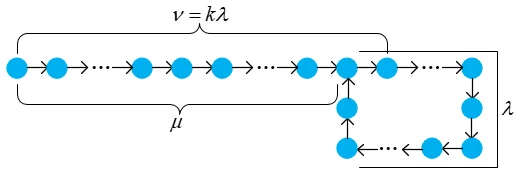
2.2 Brent's algorithm
Floyd's Tortoise and Hare算法很精巧,但是判断环存在、找到环开始位置和确定环长度需要分为三步,Brent's algorithm效率更高,且只需要两步。
Brent's algorithm也是利用了快慢两个指针的想法,但是它的想法是动态增加步长,加快搜索速度。
其基本意图是设立两个指针,尽快让第一个指针到达环内,然后第二个指针以步长1前进,再次相等时走过的步数正好是环的长度,具体做法如下。
首先,设定两个指针和,第一次先前进步,在前进的过程中若始终,则令,然后再前进,在前进的过程中若始终,则令,然后再前进......
如此,直到出现相等的位置,在出现相等位置之前,最后一次前进的步数就是环的长度。
此时,将放于序列开始位置0,放于位置,由于,故只要让和依次向前前进,等到两者指向值相同时,的位置正好就是环的开始位置。
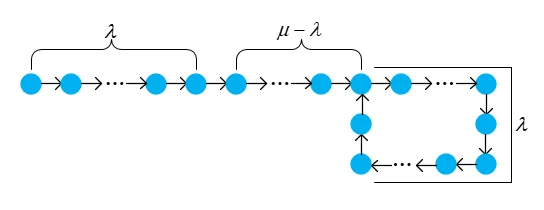
Brent's algorithm的效率比Floyd's Tortoise and Hare要高,最差情况是Floyd's Tortoise and Hare算法。其主要原因是,步长动态增加,速度提高,以及首次找到相同值时,记录了环的长度,而Floyd's Tortoise and Hare算法首次找到相同值时,并不知道环的长度,只能知道环长度的整数倍。
2.3 Gosper's algorithm
Gosper算法可以参考此处,Kino还没有细看,就不细说了。
3. 相关练习
Leetcode上有以下数题与此相关。
3.1 Leetcode 141. Linked List Cycle
Description: Given a linked list, determine if it has a cycle in it.
Floyd's Tortoise and Hare
class Solution {
public:
  bool hasCycle(ListNode *head) {
    if(!head || !(head->next)) {
      return false;
    }
    ListNode* tortoise = head->next;
    ListNode* hare = head->next->next;
    while(hare && hare->next) {
      if(tortoise == hare) {
        return true;
      }
      tortoise = tortoise->next;
      hare = hare->next->next;
    }

    return false;
  }
};
Brent's algorithm
class Solution {
public:
  bool hasCycle(ListNode *head) {
    if(!head || !(head->next)) {
      return false;
    }
    int current_step = 1;
    int limited_step = 1;
    ListNode* tortoise = head->next;
    ListNode* hare = head->next->next;
    while(hare && hare->next) {
      if(tortoise == hare) {
        return true;
      }
      if(current_step == limited_step) {
        current_step = 0;
        limited_step *= 2;
        tortoise = hare;
      }
      hare = hare->next;
      current_step++;
    }

    return false;
  }
};
3.2 Leetcode 142. Linked List Cycle II
Description: Given a linked list, return the node where the cycle begins. If there is no cycle, return null.
Floyd's Tortoise and Hare
class Solution {
public:
  ListNode *detectCycle(ListNode *head) {
    if(!head || !(head->next)) {
      return NULL;
    }
    ListNode* tortoise = head->next;
    ListNode* hare = head->next->next;
    while(tortoise != hare) {
      if(!hare || !(hare->next)) {
        return NULL;
      }
      tortoise = tortoise->next;
      hare = hare->next->next;
    }

    tortoise = head;
    while(tortoise != hare) {
      tortoise = tortoise->next;
      hare = hare->next;
    }

    return tortoise;
  }
};
Brent's algorithm
class Solution {
public:
  ListNode *detectCycle(ListNode *head) {
    if(!head || !(head->next)) {
      return NULL;
    }
    int current_step = 1;
    int limited_step = 1;
    ListNode* tortoise = head->next;
    ListNode* hare = head->next->next;
    while(tortoise != hare) {
      if(!hare || !(hare->next)) {
        return NULL;
      }
      if(current_step == limited_step) {
        current_step = 0;
        limited_step *= 2;
        tortoise = hare;
      }
      hare = hare->next;
      current_step++;
    }

    tortoise = head;
    hare = head;
    while(current_step--) {
      tortoise = tortoise->next;
    }

    while(tortoise != hare) {
      tortoise = tortoise->next;
      hare = hare->next;
    }

    return tortoise;
  }
};
3.3 Leetcode 202. Happy Number
Description: Write an algorithm to determine if a number is "happy". A happy number is a number defined by the following process: Starting with any positive integer, replace the number by the sum of the squares of its digits, and repeat the process until the number equals 1 (where it will stay), or it loops endlessly in a cycle which does not include 1. Those numbers for which this process ends in 1 are happy numbers.
Floyd's Tortoise and Hare
class Solution {
public:
  bool isHappy(int n) {
    int tortoise = nextNum(n);
    int hare = nextNum(nextNum(n));
    while(tortoise != hare) {
      tortoise = nextNum(tortoise);
      hare = nextNum(nextNum(hare));
    }

    return tortoise == 1;
  }

  int nextNum(int n) {
    int nxt = 0;
    while(n) {
      int digit = n%10;
      nxt += digit*digit;
      n /= 10;
    }

    return nxt;
  }
};
Brent's algorithm
class Solution {
public:
  bool isHappy(int n) {
    int current_step = 1;
    int limited_step = 1;
    int tortoise = nextNum(n);
    int hare = nextNum(nextNum(n));
    while(tortoise != hare) {
      if(current_step == limited_step) {
        current_step = 0;
        limited_step *= 2;
        tortoise = hare;
      }
      hare = nextNum(hare);
      current_step++;
    }

    return tortoise == 1;
  }

  int nextNum(int n) {
    int nxt = 0;
    while(n) {
      int digit = n%10;
      nxt += digit*digit;
      n /= 10;
    }

    return nxt;
  }
};
3.4 Leetcode 287. Find the Duplicate Number
Given an array nums containing n + 1 integers where each integer is between 1 and n (inclusive), prove that at least one duplicate number must exist. Assume that there is only one duplicate number, find the duplicate one.
Floyd's Tortoise and Hare
class Solution {
private:
  vector<int> nums;
public:
  int findDuplicate(vector<int>& nums) {
    if(nums.empty()) {
      return -1;
    }
    this->nums = nums;

    int tortoise = f(nums[0]);
    int hare = f(f(nums[0]));
    while(tortoise != hare) {
      tortoise = f(tortoise);
      hare = f(f(hare));
    }

    tortoise = nums[0];
    while(tortoise != hare) {
      tortoise = f(tortoise);
      hare = f(hare);
    }

    return tortoise;
  }

  int f(int n) {
    return nums[n];
  }
};
Brent's algorithm
class Solution {
private:
  vector<int> nums;
public:
  int findDuplicate(vector<int>& nums) {
    if(nums.empty()) {
      return -1;
    }
    this->nums = nums;

    int current_step = 1;
    int limited_step = 1;
    int tortoise = f(nums[0]);
    int hare = f(f(nums[0]));
    while(tortoise != hare) {
      if(current_step == limited_step) {
        current_step = 0;
        limited_step *= 2;
        tortoise = hare;
      }
      hare = f(hare);
      current_step++;
    }

    tortoise = nums[0];
    hare = nums[0];
    while(current_step--) {
      tortoise = f(tortoise);
    }

    while(tortoise != hare) {
      tortoise = f(tortoise);
      hare = f(hare);
    }

    return tortoise;
  }

  int f(int n) {
    return nums[n];
  }
};
4. 实际应用
环检测(cycle detection)问题的实际应用有 伪随机数生成器(pseudorandom number generators)强度的度量,比如 线性同余生成器(linear congruential generator),加密哈希函数的冲突检测,细胞自动机(cellular automaton)的振荡周期配置等